

5.2: Probability in Graphs and the Bigger Picture
- Page ID
- 56640

\( \newcommand{\vecs}[1]{\overset { \scriptstyle \rightharpoonup} {\mathbf{#1}} } \)
\( \newcommand{\vecd}[1]{\overset{-\!-\!\rightharpoonup}{\vphantom{a}\smash {#1}}} \)
\( \newcommand{\dsum}{\displaystyle\sum\limits} \)
\( \newcommand{\dint}{\displaystyle\int\limits} \)
\( \newcommand{\dlim}{\displaystyle\lim\limits} \)
\( \newcommand{\id}{\mathrm{id}}\) \( \newcommand{\Span}{\mathrm{span}}\)
( \newcommand{\kernel}{\mathrm{null}\,}\) \( \newcommand{\range}{\mathrm{range}\,}\)
\( \newcommand{\RealPart}{\mathrm{Re}}\) \( \newcommand{\ImaginaryPart}{\mathrm{Im}}\)
\( \newcommand{\Argument}{\mathrm{Arg}}\) \( \newcommand{\norm}[1]{\| #1 \|}\)
\( \newcommand{\inner}[2]{\langle #1, #2 \rangle}\)
\( \newcommand{\Span}{\mathrm{span}}\)
\( \newcommand{\id}{\mathrm{id}}\)
\( \newcommand{\Span}{\mathrm{span}}\)
\( \newcommand{\kernel}{\mathrm{null}\,}\)
\( \newcommand{\range}{\mathrm{range}\,}\)
\( \newcommand{\RealPart}{\mathrm{Re}}\)
\( \newcommand{\ImaginaryPart}{\mathrm{Im}}\)
\( \newcommand{\Argument}{\mathrm{Arg}}\)
\( \newcommand{\norm}[1]{\| #1 \|}\)
\( \newcommand{\inner}[2]{\langle #1, #2 \rangle}\)
\( \newcommand{\Span}{\mathrm{span}}\) \( \newcommand{\AA}{\unicode[.8,0]{x212B}}\)
\( \newcommand{\vectorA}[1]{\vec{#1}} % arrow\)
\( \newcommand{\vectorAt}[1]{\vec{\text{#1}}} % arrow\)
\( \newcommand{\vectorB}[1]{\overset { \scriptstyle \rightharpoonup} {\mathbf{#1}} } \)
\( \newcommand{\vectorC}[1]{\textbf{#1}} \)
\( \newcommand{\vectorD}[1]{\overrightarrow{#1}} \)
\( \newcommand{\vectorDt}[1]{\overrightarrow{\text{#1}}} \)
\( \newcommand{\vectE}[1]{\overset{-\!-\!\rightharpoonup}{\vphantom{a}\smash{\mathbf {#1}}}} \)
\( \newcommand{\vecs}[1]{\overset { \scriptstyle \rightharpoonup} {\mathbf{#1}} } \)
\(\newcommand{\longvect}{\overrightarrow}\)
\( \newcommand{\vecd}[1]{\overset{-\!-\!\rightharpoonup}{\vphantom{a}\smash {#1}}} \)
\(\newcommand{\avec}{\mathbf a}\) \(\newcommand{\bvec}{\mathbf b}\) \(\newcommand{\cvec}{\mathbf c}\) \(\newcommand{\dvec}{\mathbf d}\) \(\newcommand{\dtil}{\widetilde{\mathbf d}}\) \(\newcommand{\evec}{\mathbf e}\) \(\newcommand{\fvec}{\mathbf f}\) \(\newcommand{\nvec}{\mathbf n}\) \(\newcommand{\pvec}{\mathbf p}\) \(\newcommand{\qvec}{\mathbf q}\) \(\newcommand{\svec}{\mathbf s}\) \(\newcommand{\tvec}{\mathbf t}\) \(\newcommand{\uvec}{\mathbf u}\) \(\newcommand{\vvec}{\mathbf v}\) \(\newcommand{\wvec}{\mathbf w}\) \(\newcommand{\xvec}{\mathbf x}\) \(\newcommand{\yvec}{\mathbf y}\) \(\newcommand{\zvec}{\mathbf z}\) \(\newcommand{\rvec}{\mathbf r}\) \(\newcommand{\mvec}{\mathbf m}\) \(\newcommand{\zerovec}{\mathbf 0}\) \(\newcommand{\onevec}{\mathbf 1}\) \(\newcommand{\real}{\mathbb R}\) \(\newcommand{\twovec}[2]{\left[\begin{array}{r}#1 \\ #2 \end{array}\right]}\) \(\newcommand{\ctwovec}[2]{\left[\begin{array}{c}#1 \\ #2 \end{array}\right]}\) \(\newcommand{\threevec}[3]{\left[\begin{array}{r}#1 \\ #2 \\ #3 \end{array}\right]}\) \(\newcommand{\cthreevec}[3]{\left[\begin{array}{c}#1 \\ #2 \\ #3 \end{array}\right]}\) \(\newcommand{\fourvec}[4]{\left[\begin{array}{r}#1 \\ #2 \\ #3 \\ #4 \end{array}\right]}\) \(\newcommand{\cfourvec}[4]{\left[\begin{array}{c}#1 \\ #2 \\ #3 \\ #4 \end{array}\right]}\) \(\newcommand{\fivevec}[5]{\left[\begin{array}{r}#1 \\ #2 \\ #3 \\ #4 \\ #5 \\ \end{array}\right]}\) \(\newcommand{\cfivevec}[5]{\left[\begin{array}{c}#1 \\ #2 \\ #3 \\ #4 \\ #5 \\ \end{array}\right]}\) \(\newcommand{\mattwo}[4]{\left[\begin{array}{rr}#1 \amp #2 \\ #3 \amp #4 \\ \end{array}\right]}\) \(\newcommand{\laspan}[1]{\text{Span}\{#1\}}\) \(\newcommand{\bcal}{\cal B}\) \(\newcommand{\ccal}{\cal C}\) \(\newcommand{\scal}{\cal S}\) \(\newcommand{\wcal}{\cal W}\) \(\newcommand{\ecal}{\cal E}\) \(\newcommand{\coords}[2]{\left\{#1\right\}_{#2}}\) \(\newcommand{\gray}[1]{\color{gray}{#1}}\) \(\newcommand{\lgray}[1]{\color{lightgray}{#1}}\) \(\newcommand{\rank}{\operatorname{rank}}\) \(\newcommand{\row}{\text{Row}}\) \(\newcommand{\col}{\text{Col}}\) \(\renewcommand{\row}{\text{Row}}\) \(\newcommand{\nul}{\text{Nul}}\) \(\newcommand{\var}{\text{Var}}\) \(\newcommand{\corr}{\text{corr}}\) \(\newcommand{\len}[1]{\left|#1\right|}\) \(\newcommand{\bbar}{\overline{\bvec}}\) \(\newcommand{\bhat}{\widehat{\bvec}}\) \(\newcommand{\bperp}{\bvec^\perp}\) \(\newcommand{\xhat}{\widehat{\xvec}}\) \(\newcommand{\vhat}{\widehat{\vvec}}\) \(\newcommand{\uhat}{\widehat{\uvec}}\) \(\newcommand{\what}{\widehat{\wvec}}\) \(\newcommand{\Sighat}{\widehat{\Sigma}}\) \(\newcommand{\lt}{<}\) \(\newcommand{\gt}{>}\) \(\newcommand{\amp}{&}\) \(\definecolor{fillinmathshade}{gray}{0.9}\)We will see shortly that the normal distribution is the key to how probability works for our purposes. To understand exactly how, let’s first look at a simple, intuitive example using pie charts.
Probability in Pie Charts
Recall that a pie chart represents how frequently a category was observed and that all slices of the pie chart add up to 100%, or 1. This means that if we randomly select an observation from the data used to create the pie chart, the probability of it taking on a specific value is exactly equal to the size of that category’s slice in the pie chart.
Take, for example, the pie chart in Figure \(\PageIndex{1}\) representing the favorite sports of 100 people. If you put this pie chart on a dart board and aimed blindly (assuming you are guaranteed to hit the board), the likelihood of hitting the slice for any given sport would be equal to the size of that slice. So, the probability of hitting the baseball slice is the highest at 36%. The probability is equal to the proportion of the chart taken up by that section.

We can also add slices together. For instance, maybe we want to know the probability of finding someone whose favorite sport is usually played on grass. The outcomes that satisfy this criterion are baseball, football, and soccer. To get the probability, we simply add their slices together to see what proportion of the area of the pie chart is in that region: 36% + 25% + 20% = 81%. We can also add sections together even if they do not touch. If we want to know the likelihood that someone’s favorite sport is not called football somewhere in the world (i.e., baseball and hockey), we can add those slices even though they aren’t adjacent or contiguous in the chart itself: 36% + 20% = 56%. We are able to do all of this because (1) the size of the slice corresponds to the area of the chart taken up by that slice, (2) the percentage for a specific category can be represented as a decimal (this step was skipped for ease of explanation above), and (3) the total area of the chart is equal to 100% or 1.0, which makes the size of the slices interpretable.
Probability in Normal Distributions
If the language at the end of the last section sounded familiar, that’s because it's exactly the language used in Chapter 4 to describe the normal distribution. Recall that the normal distribution has an area under its curve that is equal to 1 and that it can be split into sections by drawing a line through it that corresponds to a given z-score. Because of this, we can interpret areas under the normal curve as probabilities that correspond to z scores.
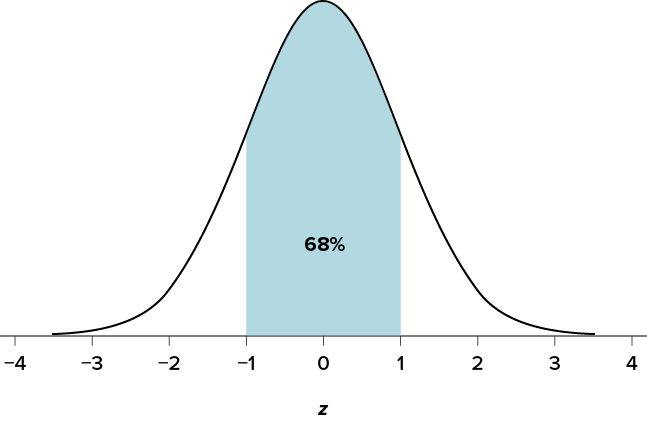
First, let’s look at the area between z = −1.00 and z = 1.00 presented in Figure \(\PageIndex{2}\). We were told earlier that this region contains 68% of the area under the curve. Thus, if we randomly chose a z score from all possible z scores, there is a 68% chance that it will be between z = −1.00 and z = 1.00 because those are the z scores that satisfy our criteria.
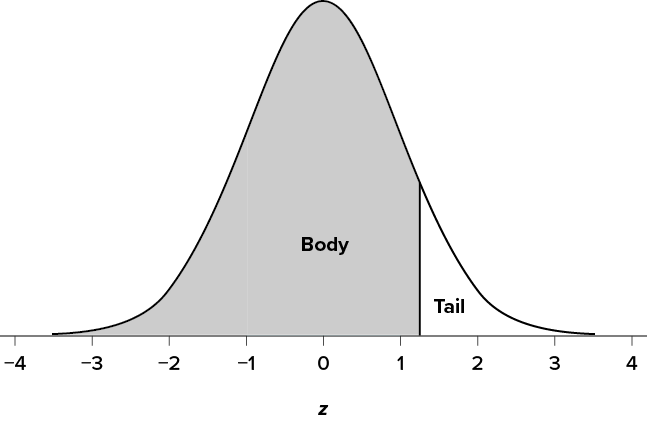
Just like a pie chart is broken up into slices by drawing lines through it, we can also draw a line through the normal distribution to split it into sections. Take a look at the normal distribution in Figure \(\PageIndex{3}\), which has a line drawn through it at z = 1.25. This line creates two sections of the distribution: the smaller section called the tail and the larger section called the body. Differentiating between the body and the tail does not depend on which side of the distribution the line is drawn. All that matters is the relative size of the pieces: bigger is always body.
As you can see, we can break up the normal distribution into 3 pieces (lower tail, body, and upper tail) as in Figure \(\PageIndex{2}\) or into 2 pieces (body and tail) as in Figure \(\PageIndex{3}\). We can then find the proportion of the area in the body and tail based on where the line was drawn (i.e., at what z-score). Mathematically, this is done using calculus. Fortunately, the exact values are given to you in the Standard Normal Distribution Table, also known as the z table. A portion of this table is shown in Table 5.1. (The entire table appears in section 16.1.) Using the z values in the table (A), we can find the area under the normal curve in any body (B), tail (C), or combination of tails, as well as the proportion between z and the mean (D).
For example, suppose we want to find the area in the body for a z-score of 1.62. As shown in Table 5.1, the row for 1.62 corresponds with a value of .9474 for the proportion in the body of the distribution. Thus, the odds of randomly selecting someone with a z score less than (to the left of) z = 1.62 is 94.74% because that is the proportion of the area taken up by values that satisfy our criteria.

The z table only presents the area in the body for positive z-scores because the normal distribution is symmetrical. Thus, the area in the body of z = 1.62 is equal to the area in the body for z = −1.62, though now—as illustrated in the middle distribution at the top of Table 5.1—the body will be the shaded area to the right of z. (When in doubt, drawing out your distribution and shading the area you need to find will always help.) Because the total area under the normal curve is always equal to 1.00, the area in the tail (Column C) is simply the area in the body (Column B) subtracted from 1.00 (1.00 − .9474 = .0526).
Let’s look at another example. This time, let’s find the area corresponding to z scores more extreme than z = −1.96 and z = 1.96. That is, let’s find the area in the tails of the distribution for values less than z = −1.96 (farther negative and therefore more extreme) and greater than z = 1.96 (farther positive and therefore more extreme). This region is illustrated in Figure \(\PageIndex{4}\).

Let’s start with the tail for z = 1.96. If we go to the z table, we will find that the area in the tail to the right of z = 1.96 is equal to .0250. Because the normal distribution is symmetrical, the area in the tail for z = −1.96 is the exact same value, .0250. Finally, to get the total area in the shaded region, we simply add the areas together to get .0500. Thus, there is a 5% chance of randomly getting a value more extreme than z = −1.96 or z = 1.96 (this particular value and region will become incredibly important in Unit 2).
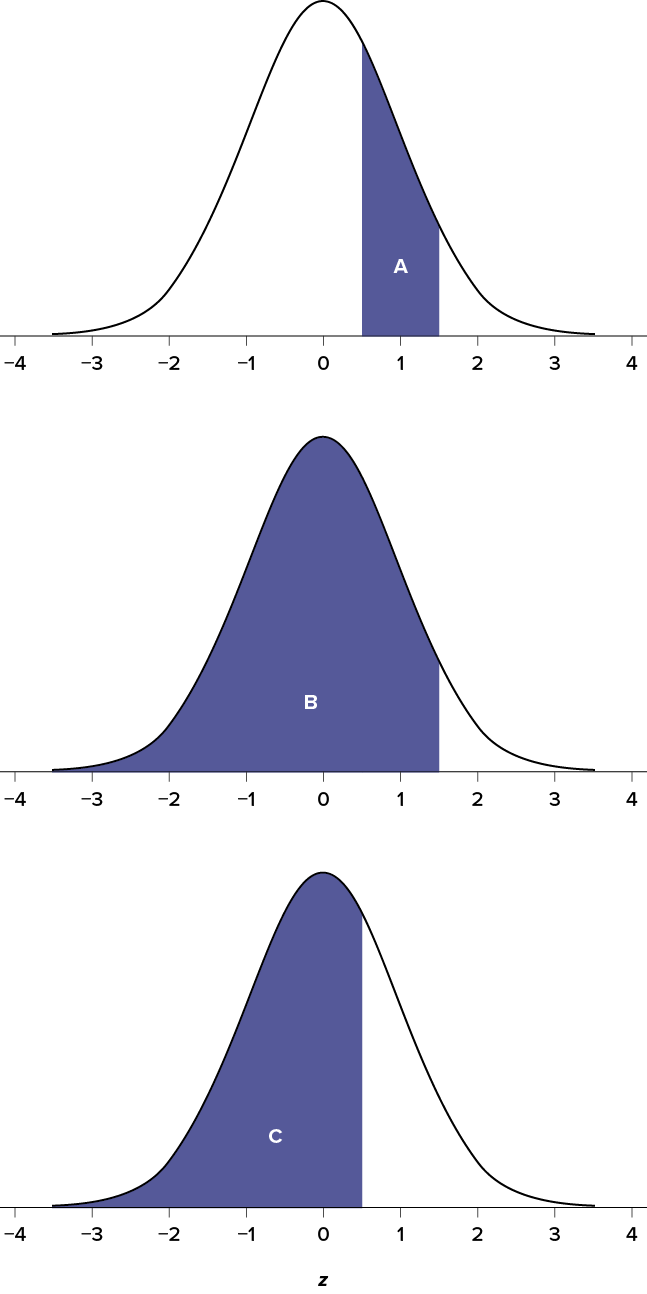
Finally, we can find the area between two z-scores by shading and subtracting. Figure \(\PageIndex{5}\) shows the area between z = 0.50 and z = 1.50. Because this is a subsection of a body (rather than just a body or a tail), we must first find the larger of the two bodies, in this case, the body for z = 1.50, and subtract the smaller of the two bodies, or the body for z = 0.50. Aligning the distributions vertically, as in Figure \(\PageIndex{5}\), makes this clearer. From the complete z table in section 16.1, we see that the area in the body for z = 1.50 is .9332, and the area in the body for z = 0.50 is .6915. Subtracting these gives us .9332 − .6915 = .2417.
Probability: The Bigger Picture
The concepts and ideas presented in this chapter are likely not intuitive at first. Probability is a tough topic for everyone, but the tools it gives us are incredibly powerful and enable us to do amazing things with data analysis. They are the heart of how inferential statistics work.
To summarize, the probability that an event happens is the number of outcomes that qualify as that event (i.e., the number of ways the event could happen) compared to the total number of outcomes (i.e., how many things are possible). This extends to graphs like a pie chart, where the biggest slices take up more of the area and are therefore more likely to be chosen at random. This idea then brings us back around to our normal distribution, which can also be broken up into regions or areas, each of which is bounded by one or two z-scores and corresponds to all z-scores in that region. The probability of randomly getting one of those z-scores in the specified region can then be found on the Standard Normal Distribution (z) table. Thus, the larger the region, the more likely an event is, and vice versa. Because the tails of the distribution are, by definition, smaller, and we go farther out into the tail, the likelihood or probability of finding a result out in the extremes becomes small.
Question \(\PageIndex{1}\)
Question \(\PageIndex{2}\)
Question \(\PageIndex{3}\)
Question \(\PageIndex{4}\)
Question \(\PageIndex{5}\)