

14.4: Hypothesis Test for Simple Linear Regression
- Page ID
- 20929

\( \newcommand{\vecs}[1]{\overset { \scriptstyle \rightharpoonup} {\mathbf{#1}} } \)
\( \newcommand{\vecd}[1]{\overset{-\!-\!\rightharpoonup}{\vphantom{a}\smash {#1}}} \)
\( \newcommand{\dsum}{\displaystyle\sum\limits} \)
\( \newcommand{\dint}{\displaystyle\int\limits} \)
\( \newcommand{\dlim}{\displaystyle\lim\limits} \)
\( \newcommand{\id}{\mathrm{id}}\) \( \newcommand{\Span}{\mathrm{span}}\)
( \newcommand{\kernel}{\mathrm{null}\,}\) \( \newcommand{\range}{\mathrm{range}\,}\)
\( \newcommand{\RealPart}{\mathrm{Re}}\) \( \newcommand{\ImaginaryPart}{\mathrm{Im}}\)
\( \newcommand{\Argument}{\mathrm{Arg}}\) \( \newcommand{\norm}[1]{\| #1 \|}\)
\( \newcommand{\inner}[2]{\langle #1, #2 \rangle}\)
\( \newcommand{\Span}{\mathrm{span}}\)
\( \newcommand{\id}{\mathrm{id}}\)
\( \newcommand{\Span}{\mathrm{span}}\)
\( \newcommand{\kernel}{\mathrm{null}\,}\)
\( \newcommand{\range}{\mathrm{range}\,}\)
\( \newcommand{\RealPart}{\mathrm{Re}}\)
\( \newcommand{\ImaginaryPart}{\mathrm{Im}}\)
\( \newcommand{\Argument}{\mathrm{Arg}}\)
\( \newcommand{\norm}[1]{\| #1 \|}\)
\( \newcommand{\inner}[2]{\langle #1, #2 \rangle}\)
\( \newcommand{\Span}{\mathrm{span}}\) \( \newcommand{\AA}{\unicode[.8,0]{x212B}}\)
\( \newcommand{\vectorA}[1]{\vec{#1}} % arrow\)
\( \newcommand{\vectorAt}[1]{\vec{\text{#1}}} % arrow\)
\( \newcommand{\vectorB}[1]{\overset { \scriptstyle \rightharpoonup} {\mathbf{#1}} } \)
\( \newcommand{\vectorC}[1]{\textbf{#1}} \)
\( \newcommand{\vectorD}[1]{\overrightarrow{#1}} \)
\( \newcommand{\vectorDt}[1]{\overrightarrow{\text{#1}}} \)
\( \newcommand{\vectE}[1]{\overset{-\!-\!\rightharpoonup}{\vphantom{a}\smash{\mathbf {#1}}}} \)
\( \newcommand{\vecs}[1]{\overset { \scriptstyle \rightharpoonup} {\mathbf{#1}} } \)
\(\newcommand{\longvect}{\overrightarrow}\)
\( \newcommand{\vecd}[1]{\overset{-\!-\!\rightharpoonup}{\vphantom{a}\smash {#1}}} \)
\(\newcommand{\ket}[1]{\left| #1 \right>}\)
\(\newcommand{\bra}[1]{\left< #1 \right|}\)
\(\newcommand{\braket}[2]{\left< #1 \vphantom{#2} \right| \left. #2 \vphantom{#1} \right>}\)
\(\newcommand{\braopket}[3]{\left< #1 \vphantom{#2}\vphantom{#3} \right| #2 \vphantom{#1}\vphantom{#3} \left| #3 \vphantom{#1}\vphantom{#2} \right>}\)
\(\newcommand{\qmvec}[1]{\mathbf{\vec{#1}}}\)
\(\newcommand{\op}[1]{\hat{\mathbf{#1}}}\)
\(\newcommand{\expect}[1]{\langle #1 \rangle}\)
\(\newcommand{\dfn}[1]{\emph{\textbf{#1}}}\)
We will now describe a hypothesis test to determine if the regression model is meaningful; in other words, does the value of \(X\) in any way help predict the expected value of \(Y\)?
Model Assumptions
- The residual errors are random and are normally distributed.
- The standard deviation of the residual error does not depend on \(X\)
- A linear relationship exists between \(X\) and \(Y\)
- The samples are randomly selected
Test Hypotheses
\(H_o\): \(X\) and \(Y\) are not correlated
\(H_a\): \(X\) and \(Y\) are correlated
\(H_o\): \(\beta_1\) (slope) = 0
\(H_a\): \(\beta_1\) (slope) ≠ 0
Test Statistic
\(F=\dfrac{M S_{\text {Regression }}}{M S_{\text {Error }}}\)
\(d f_{\text {num }}=1\)
\(d f_{\text {den }}=n-2\)
Sum of Squares
\(S S_{\text {Total }}=\sum(Y-\bar{Y})^{2}\)
\(S S_{\text {Error }}=\sum(Y-\hat{Y})^{2}\)
\(S S_{\text {Regression }}=S S_{\text {Total }}-S S_{\text {Error }}\)
In simple linear regression, this is equivalent to saying “Are X an Y correlated?”
In reviewing the model, \(Y=\beta_{0}+\beta_{1} X+\varepsilon\), as long as the slope (\(\beta_{1}\)) has any non‐zero value, \(X\) will add value in helping predict the expected value of \(Y\). However, if there is no correlation between X and Y, the value of the slope (\(\beta_{1}\)) will be zero. The model we can use is very similar to One Factor ANOVA.
The Results of the test can be summarized in a special ANOVA table:
| Source of Variation | Sum of Squares (SS) | Degrees of freedom (df) | Mean Square (MS) | \(F\) |
|---|---|---|---|---|
| Factor (due to X) | \(\mathrm{SS}_{\text {Regression }}\) | 1 | \(\mathrm{MS}_{\text {Factor }}=\mathrm{SS}_{\text {Factor }} / 1\) | \(\mathrm{F}=\mathrm{MS}_{\text {Factor }} / \mathrm{MS}_{\text {Error }}\) |
| Error (Residual) | \(\mathrm{SS}_{\text {Error }}\) | \(n-2\) | \(\mathrm{MS}_{\text {Error }}=\mathrm{SS}_{\text {Error }} / \mathrm{n}-2\) | |
| Total | \(\mathrm{SS}_{\text {Total }}\) | \(n-1\) |
Design: Is there a significant correlation between rainfall and sales of sunglasses?
Research Hypotheses:
\(H_o\): Sales and Rainfall are not correlated \(H_o\): 1 (slope) = 0
\(H_a\): Sales and Rainfall are correlated \(H_a\): 1 (slope) ≠ 0
Type I error would be to reject the Null Hypothesis and \(t\) claim that rainfall is correlated with sales of sunglasses, when they are not correlated. The test will be run at a level of significance (\(\alpha\)) of 5%.
The test statistic from the table will be \(\mathrm{F}=\dfrac{\text { MSRegression }}{\text { MSError }}\). The degrees of freedom for the numerator will be 1, and the degrees of freedom for denominator will be 5‐2=3.
Critical Value for \(F\) at \(\alpha\)of 5% with \(df_{num}=1\) and \(df_{den}=3} is 10.13. Reject \(H_o\) if \(F >10.13\). We will also run this test using the \(p\)‐value method with statistical software, such as Minitab.
Data/Results
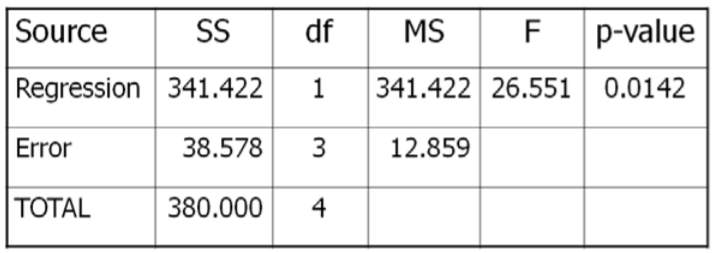
\(F=341.422 / 12.859=26.551\), which is more than the critical value of 10.13, so Reject \(H_o\). Also, the \(p\)‐value = 0.0142 < 0.05 which also supports rejecting \(H_o\).
Conclusion
Sales of Sunglasses and Rainfall are negatively correlated.